
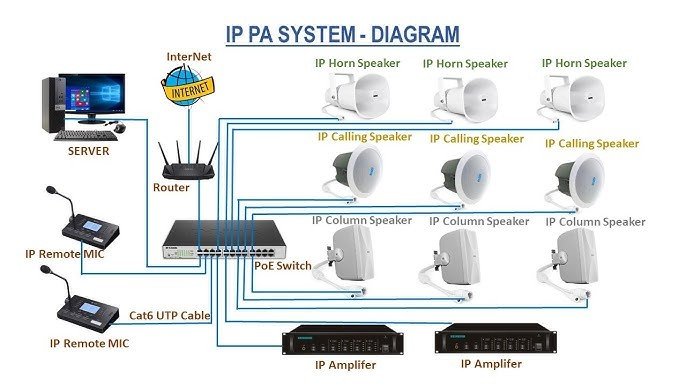
For an IP-based PA system, certain types of network infrastructure are mandatory to ensure smooth operation. These systems rely on IT networks rather than traditional audio cabling, so the backbone must be robust and reliable.
🏗️ Mandatory Network Infrastructure Components
LAN/WAN Network
- A stable Ethernet-based local area network (LAN) or wide area network (WAN) is essential.
Provides the backbone for transmitting audio signals digitally.
Switches & Routers
- Managed network switches handle traffic between IP speakers, controllers, and servers.
- Routers connect different network segments or remote sites if paging is needed across multiple locations.
PoE (Power over Ethernet) Support
- Many IP speakers are powered directly through Ethernet cables.
Requires PoE-enabled switches or injectors to avoid separate power wiring.
IP Audio Server / Controller
- Acts as the “brain” of the system, managing announcements, scheduling, and zone control.
- Supports unicast/multicast streaming for efficient audio distribution.
Structured Cabling (Cat5e/Cat6 or higher)
- Ensures reliable data transfer with minimal latency.
- Higher-grade cabling supports gigabit speeds and future scalability.
Network Security & QoS (Quality of Service)
- Firewalls and VLANs protect the system from unauthorized access.
- QoS ensures audio packets are prioritized, preventing delays or dropouts.
📌 Optional but Recommended
- Wi-Fi Access Points – for mobile paging consoles or wireless microphones.
- Cloud/Remote Management – allows administrators to control the PA system from anywhere.
- Redundant Network Paths – backup links to ensure announcements still work during outages.
In short: LAN + PoE switches + IP controller + structured cabling are the mandatory infrastructure pieces for an IP PA system.